
Automation follows rules. Autonomy applies judgment. The gap between those two words is the distance between a scheduled sync and an AI SmartAgent. The word “automation” has been in the enterprise software vocabulary for decades. Workflow triggers, scheduled syncs, rule-based routing — all of these are automation. They’re useful. But they’re not intelligent. AI SmartAgents represent a different category entirely.
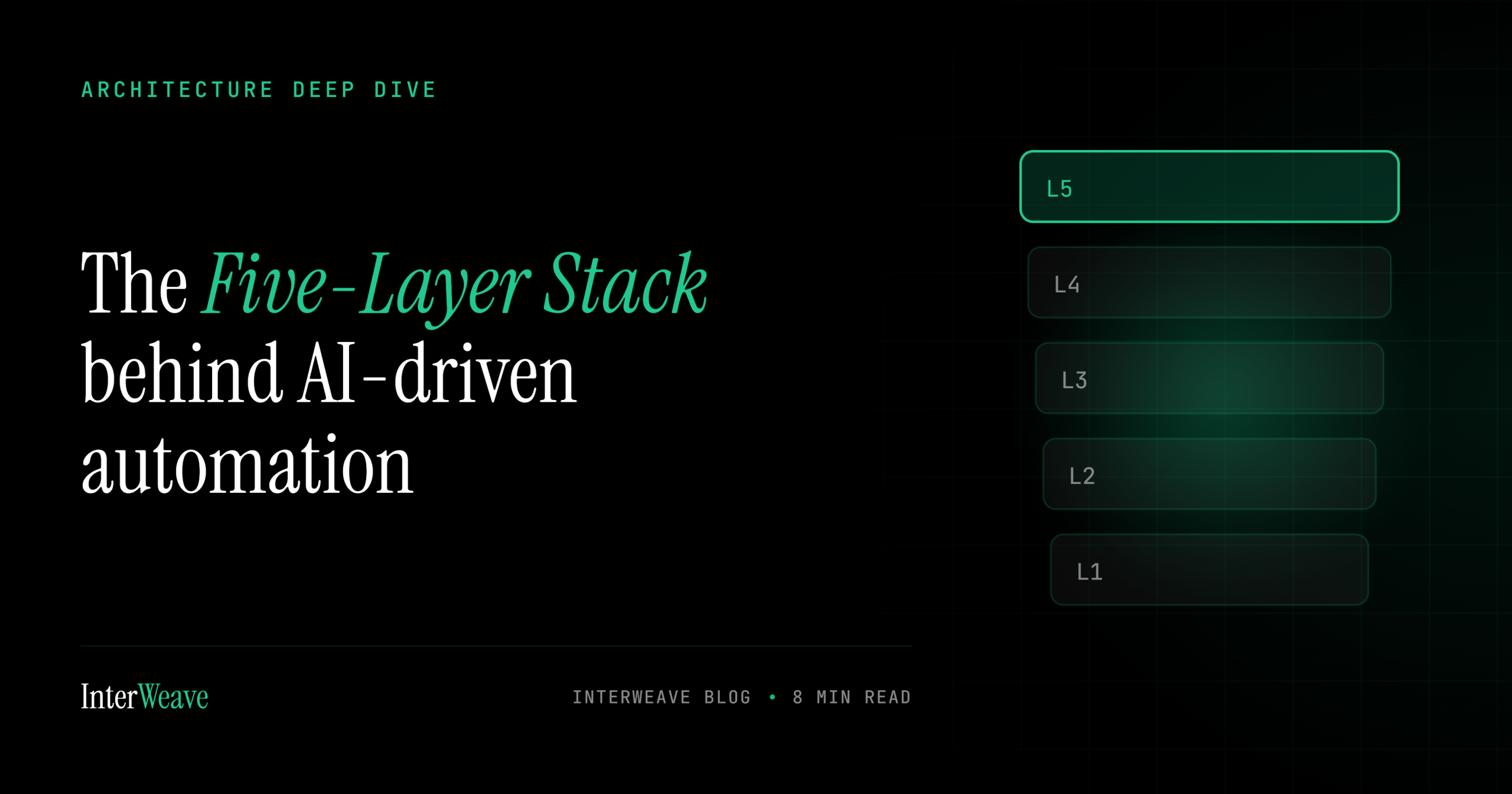
Most AI integrations fail not because the AI isn’t capable — but because the data foundation beneath it isn’t structured enough to act on. The InterWeave Automation Platform^AI is built on five distinct layers, each with a defined responsibility. Understanding how they interconnect is the key to understanding why the platform can do what it does — and why stacking AI on top of poor integration infrastructure produces expensive disappointment.
When InterWeave formally renamed its product to the InterWeave Automation Platform^AI, the superscript was a deliberate choice. Not “Platform with AI.” Not “Platform Plus AI.” The caret — the exponent marker — signals something multiplicative, not additive. This document is a plain-language explanation of what changed, why it matters, and what it means for every mid-market business running on InterWeave today.

Every finance team knows the feeling of the endless data loop. The day starts with Salesforce or another CRM, jumps into QuickBooks or NetSuite, hops over to Stripe, PayPal, and a banking portal, then lands in Excel for copy‑and‑paste marathons. By…
The problem: Most organizations today still treat CRM, payments, and financial systems as three separate silos. That creates friction, PCI exposure, reporting delays, and hours of manual double-entry. The solution: A fully connected payment and…
When integrating platforms like Salesforce, QuickBooks, Sage, payment gateways, or ERP systems, one of the biggest risks is data inconsistency—leading to errors in reporting, billing, or customer communications. Ensuring data integrity is not just about syncing data; it’s about syncing it accurately, completely, and…
Real Results Through Integration with Salesforce and Authorize.net A mid-sized U.S.-based nonprofit organization focused on education and community outreach was struggling with manual donation tracking, delayed reconciliations, and lack of real-time donor insights. They relied on Salesforce Nonprofit Cloud for donor engagement and Authorize.net for payment processing—but the two systems didn’t talk…
A Guide to Open Architecture, API Flexibility, and Future-Proofing Your Tech Stack Vendor lock-in happens when businesses become overly dependent on one provider’s ecosystem—making it hard (and expensive) to switch tools or scale. But with…
Powered by real-time sync between platforms like Salesforce + QuickBooks/Sage via InterWeave SmartSolutions An integrated system should do more than sync data—it should generate actionable financial insights. With InterWeave SmartSolutions connecting your CRM and accounting…
A Customer Payment Portal is a secure, self-service web interface where customers can view invoices, make payments, set up auto-pay, and manage their billing information. When integrated with Salesforce, it creates a powerful bridge between…


